A single loop that builds the foundation every other tool assumes you already have.
ARKYPEL is one pipeline that runs continuously against your environment. It discovers, prioritizes, and validates, then feeds its own output back in so every next cycle is sharper.
A living model of your environment.
Every cycle, ARKYPEL reads the records your network already keeps, identifies each device from how it already talks, and asks where doubt remains, then resolves it all into a single graph. Servers, workstations, network gear, identities, and IoT, stitched together by the relationships that matter.
Visualization is illustrative. Real environments are larger and more interesting.
Read the records. Then ask one question.
The network already knows what is on it. ARKYPEL reads it first, identifies every device from what it already says, and only asks where doubt remains.
Every device, from records you already have.
Switch tables, the directory, DHCP, virtualization, Wi-Fi controllers and RADIUS already list what is connected, with its port and VLAN. ARKYPEL reads them with read-only credentials. No agent required, no network change to get started.
- Switch tables
- Directory
- DHCP
- Virtualization
- Wi-Fi controllers
- RADIUS
Every device betrays what it is, without being asked.
A passive engine identifies each device from how it already talks: network stack behavior, DHCP, the outer layer of encrypted sessions, industrial protocols. Nothing is sent to the device. Traffic capture becomes optional and targeted, for industrial segments or zones with unknowns.
Ask one question, only where doubt remains.
ARKYPEL knows which assets it is unsure about and picks the cheapest question that would settle each one. One lightweight query per uncertain IT device, then stop. Never an active packet in industrial zones. Credentialed inspection only on the servers you authorize.
The order is about cost and safety, not about which method matters most. Records, observation and targeted questions run as one loop.
See how Discovery worksConfidence, not a list.
Every asset comes with a type, a location (switch, port, VLAN), a confidence score and the independent sources that saw it, or an explicit 'not typable' with the reason.
Seen by the directory, DHCP and a switch: certain. Seen only by a switch: it exists, it sits on a known port, and it is flagged for typing.
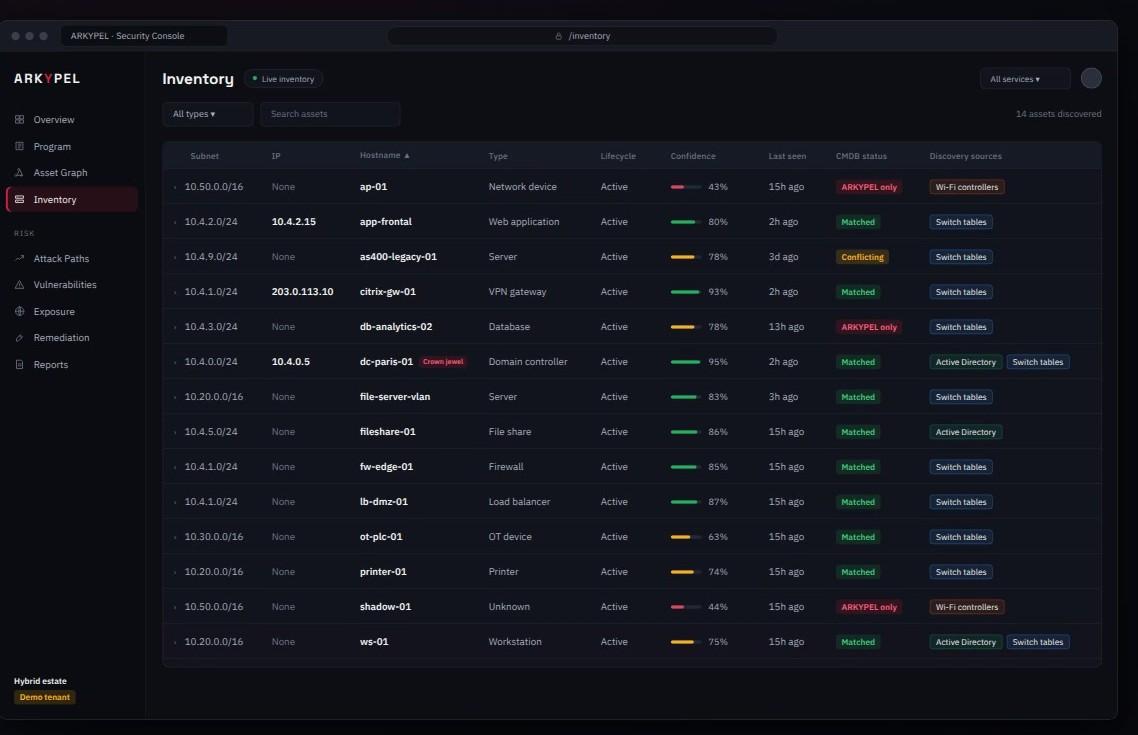
On top of the inventory, a continuous assessment.
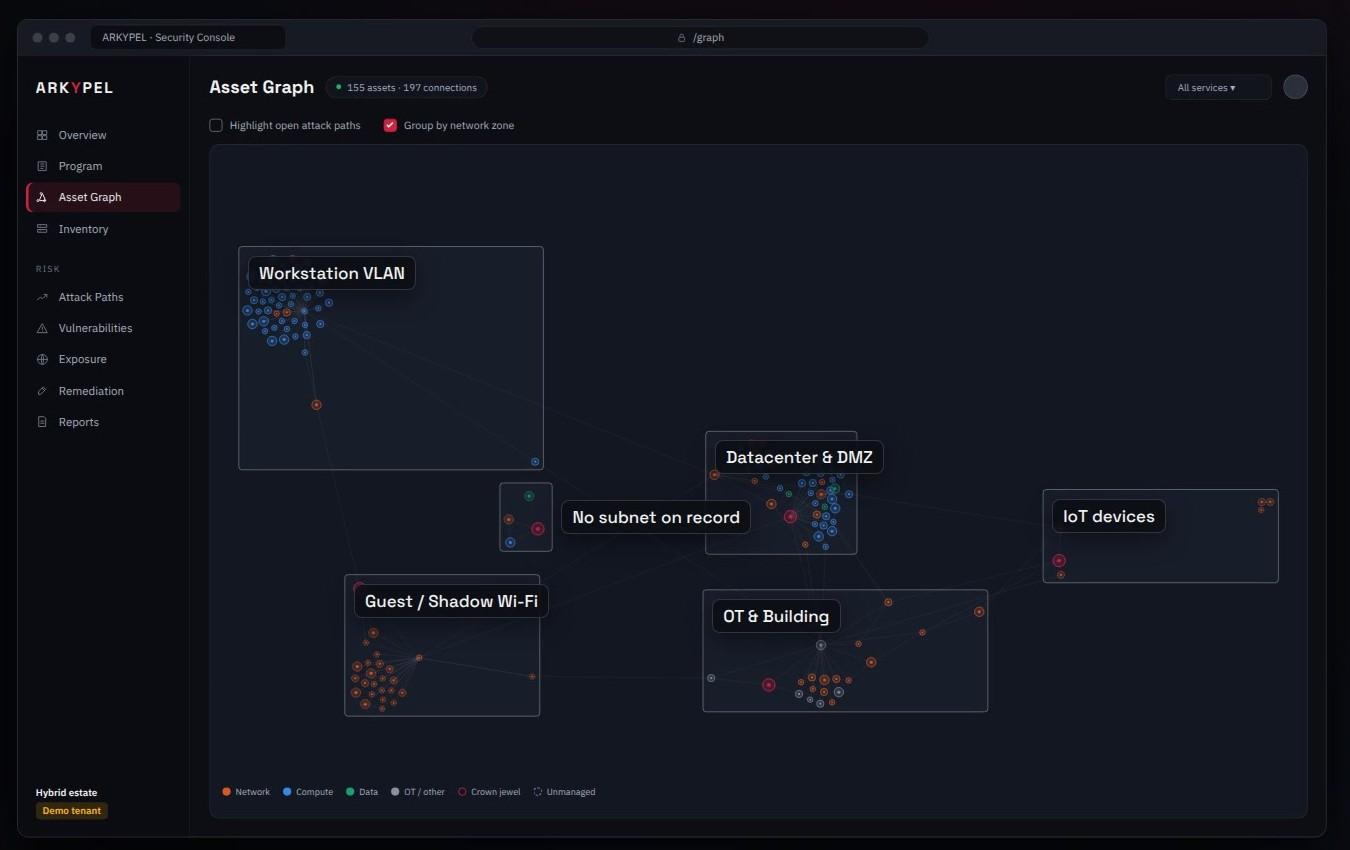
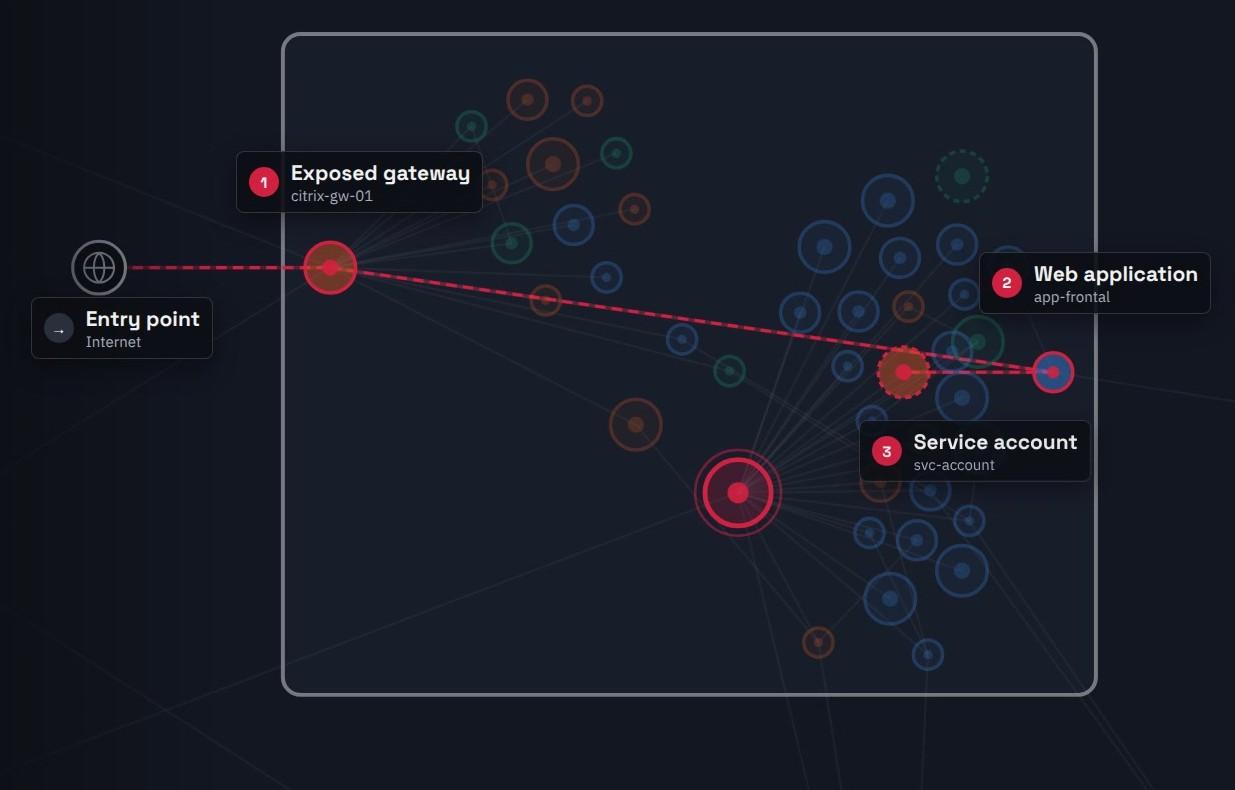
Risk that knows your environment.
Generic severity scores collapse under real workloads. ARKYPEL weights every finding against the context it just built: how this asset is exposed, who depends on it, what an attacker would chain to reach it.
The result is a queue your team can actually work, ordered by what would change the outcome of the next incident.
Prove the path, or close it.
Theoretical exposure is not actionable. ARKYPEL validates the paths that matter: which exposures are reachable, which are not, what compensating controls already stop them.
The output is a small set of confirmed exposures, with the evidence that earned them their place on the queue.
One collector. Read-only. Hosted where you need it.
- One collector VM in your environment, air-gap capable.
- Credentials, not cabling: a few read-only accounts your IT team already knows how to issue.
- No agent required on endpoints.
- Cloud and on-premises assets in one model, whichever hosting you choose.
- Industrial zones are observed, never probed.
On premises
Runs inside your perimeter, no outbound dependencies. Designed for environments where data cannot leave.
Cloud
Only the collector runs on your site. Analytics and the console are hosted in the ARKYPEL cloud, nothing else to operate.
Air-gapped
Designed to operate without internet egress. Updates flow in through a controlled channel, signals stay home.